Respiratory Rate: What Your Breathing at Night Tells You
6 min read · August 2026 · by Manikanta Sirumalla
Respiratory Rate: What Your Breathing at Night Tells You
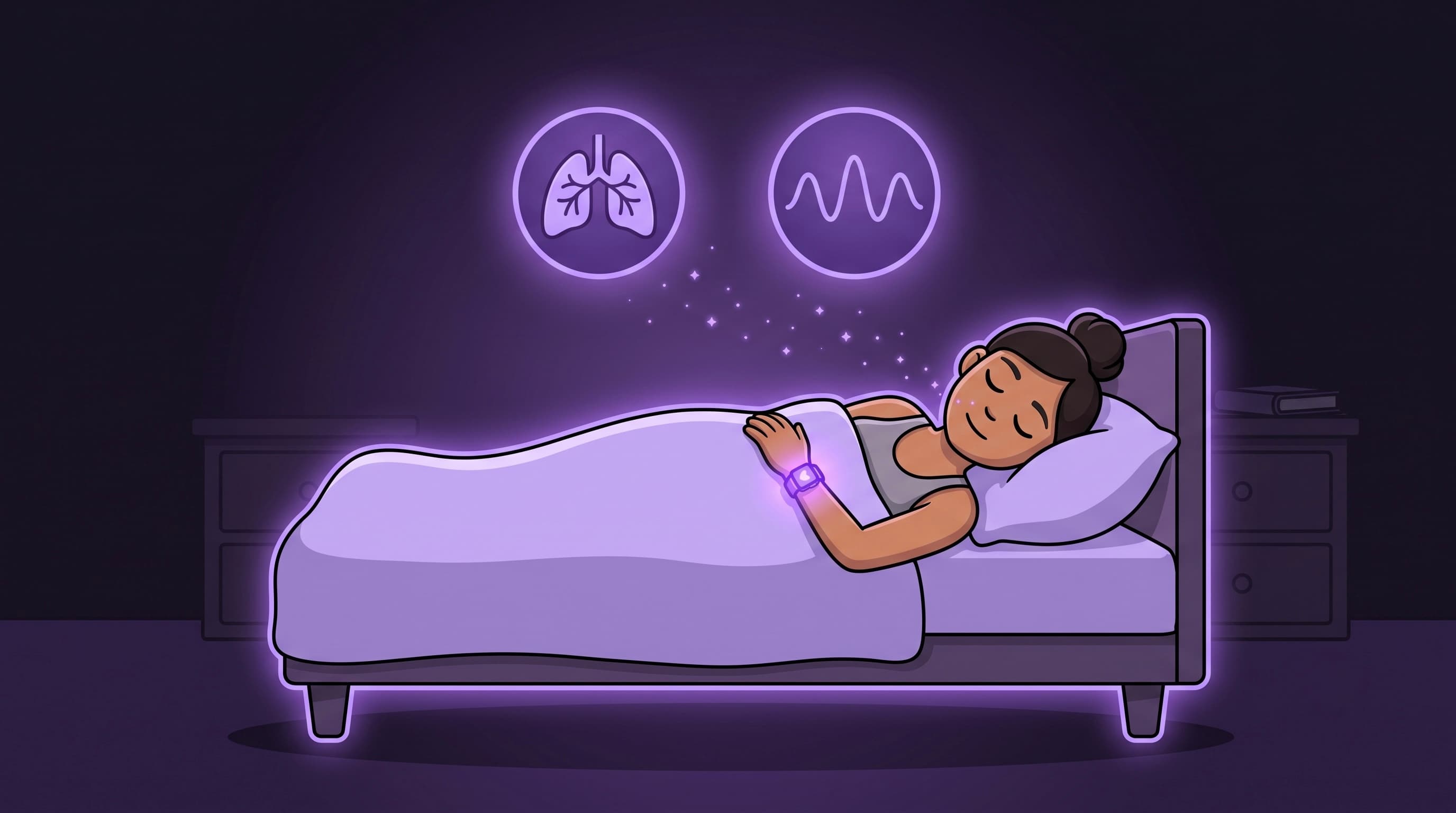
While you sleep, your Apple Watch quietly counts how many breaths you take each minute. For most healthy adults that number sits in a narrow band, often somewhere around 12 to 20 breaths per minute, and it tends to be remarkably stable night to night. That stability is exactly why a sustained move away from your usual band is worth noticing, even though neither direction is inherently "good" or "bad" on its own.
RepTrack surfaces respiratory rate in two places: on its own metric page in Health Analytics, and as a small supporting input to your Recovery score (5% of the blend when your baseline is mature enough to trust it). This article explains both.
What the number actually is
Respiratory rate is simply breaths per minute (rpm). Your watch estimates it from the motion and optical signals it collects while you sleep, not from a chest strap or a spirometer, so treat it as a trend signal, not a clinical measurement.
RepTrack reads it from Apple Health as a nightly value: the respiratory rate associated with your sleep window, the same shape as how sleeping HRV and resting heart rate are handled. On the metric page you'll see:
- Today's reading in rpm, with one decimal place.
- A 7-day average and the range over your selected window (week, month, or six months).
- Your personal band: the "typical" range built from your last 30 days of readings.
- A % vs last month comparison, reported in neutral tone (see below).
If there's no reading, the page states the honest causes: Health access may be off (iOS never tells apps which types were denied), your hardware may not record it, or nothing was captured in the range, nightly vitals need the watch worn while you sleep.
Your personal band (and why we don't grade the direction)
RepTrack's Health Monitor pairs every vital with a personal range band: median ± a robust spread (MAD × 1.4826) over your last 30 days of readings, with a minimum of four data points before a band appears. Until then, the tile says "Collecting your baseline" rather than inventing a "normal" range.
For respiratory rate, the app uses neutral semantics:
- Above usual and Below usual describe where today's reading sits relative to your band.
- Neither direction gets a green "good" or amber "bad" pill, because the same shift can mean different things (a cooler room, a harder training block, congestion, altitude, anxiety). RepTrack reports the movement; it does not diagnose the cause.
That choice is deliberate and matches how the Recovery engine treats the signal too: elevation above your baseline can pull recovery down slightly once your history is mature, but breathing slower than usual is weak positive evidence at best, the math caps how much either direction can move the score.
How Recovery uses it (5%, baseline-only)
Inside your Recovery score, respiratory rate is a supporting signal, weighted at 5% when it is available and your personal baseline has at least 7 days of history. It never produces a Recovery score on its own, you still need HRV, resting heart rate, or sleep as a core signal.
The scoring logic is baseline-relative and asymmetric:
- Breathing faster than your usual sleep rate (illness, overreaching, poor sleep environment) is the direction that matters; it can nudge recovery down.
- Breathing slower than usual carries little upward weight, the engine caps how much "extra calm" can help, because a artificially low reading isn't necessarily recovery.
Values outside a plausible physiological window (roughly 6–40 breaths/min) are dropped entirely so a sensor glitch cannot poison today's score or tomorrow's baseline.
What can move your nightly rate
Common, non-alarming shifts:
- Room temperature and humidity: warmer rooms often correlate with slightly faster breathing.
- Altitude: breathing rate tends to run higher at elevation.
- Training load: a very hard block can leave respiration slightly elevated overnight for a night or two.
- Alcohol and late meals: both can fragment sleep and shift overnight vitals.
- Congestion or illness: often the clearest upward move; worth cross-checking how you feel and whether resting heart rate and wrist temperature moved the same way.
Because none of these have a single interpretation, the Health Monitor shows position on your band + month-over-month drift, and leaves the story to you.
How to actually use it
- Watch multi-night trends, not one night. A single elevated reading after a hard session is noise; three elevated nights with rising resting heart rate is a pattern.
- Cross-check siblings. Respiratory rate, resting heart rate, wrist temperature, and HRV often move together when you're fighting something off, one metric alone is thin evidence.
- Wear the watch to sleep. Nightly vitals without overnight wear are honestly empty, not zero.
- Don't treat it as a diagnosis. RepTrack is a training-readiness tool. Sustained unexplained changes belong in a clinical conversation if they worry you.
The bottom line
Respiratory rate is one of the quietest numbers on your Health Monitor: stable when you're stable, one of the first to drift when something systemic shifts. RepTrack reads it nightly from Apple Health, shows it against your 30-day band, compares this month to last without grading the direction, and folds a small, baseline-relative slice into Recovery when the history supports it. Report the movement; let the trend, and how you feel, tell the story.
Sources
- Mackay D, et al. "Respiratory rate: the neglected vital sign." British Journal of Hospital Medicine, 2011.
- Apple HealthKit documentation,
HKQuantityTypeIdentifierRespiratoryRateand sleep-associated samples. - RecoveryEngine D.1.5 / D.1.7 gate documentation, baseline-relative respiratory scoring and plausibility filtering.
- WHOOP / Oura product documentation, overnight respiratory rate as a supporting recovery input.