Body Fat Percentage: What It Means and How to Measure It
9 min read · April 2025 · by Manikanta Sirumalla
Body Fat Percentage: What It Means and How to Measure It
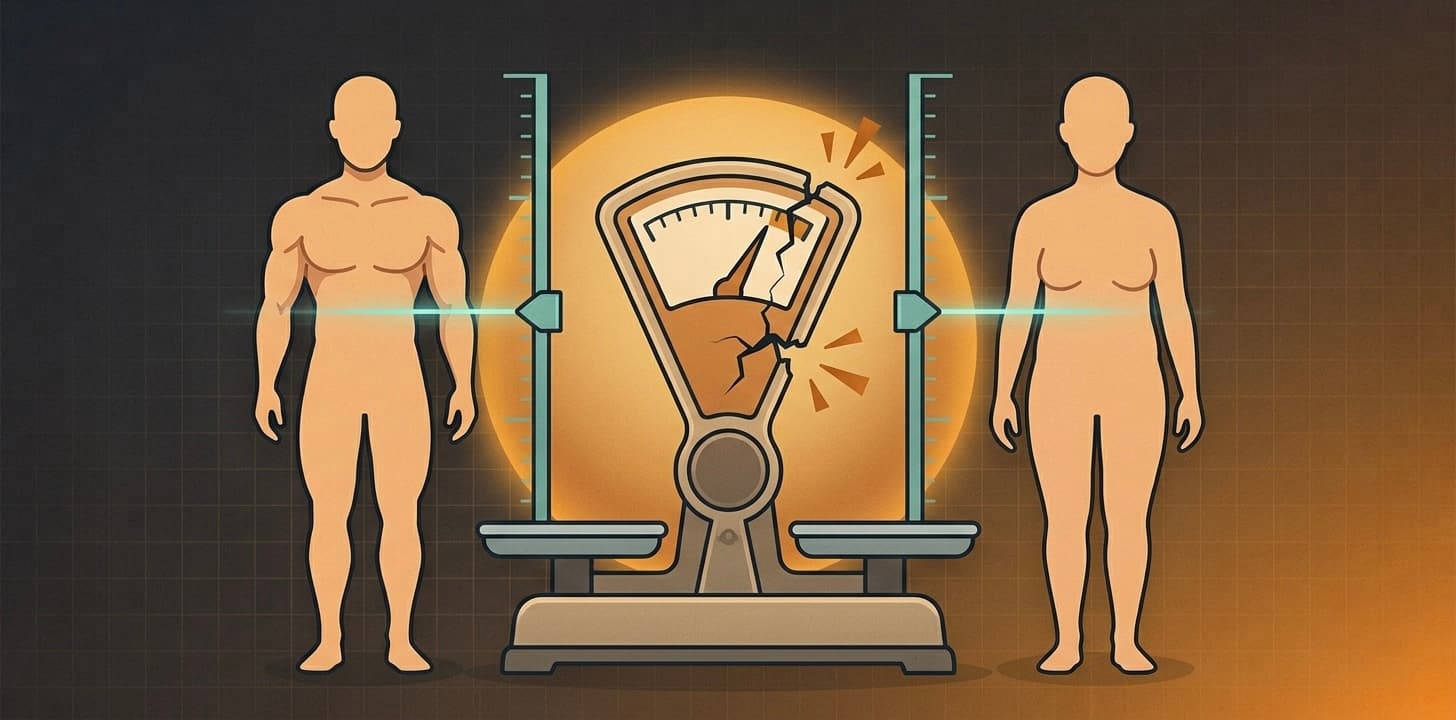
Your scale tells you one number. That number is the sum of your bones, organs, water, muscle, and fat, all collapsed into a single figure that tells you almost nothing about your health or physique. Body fat percentage changes that. It separates the signal from the noise and gives you the single most useful metric for understanding your body composition.
What Body Fat Percentage Actually Is
Body fat percentage is the proportion of your total body mass that consists of adipose tissue (fat). If you weigh 180 lbs and have 30 lbs of fat, your body fat percentage is 16.7%.
The formula is straightforward:
Body Fat % = (Fat Mass / Total Body Mass) x 100
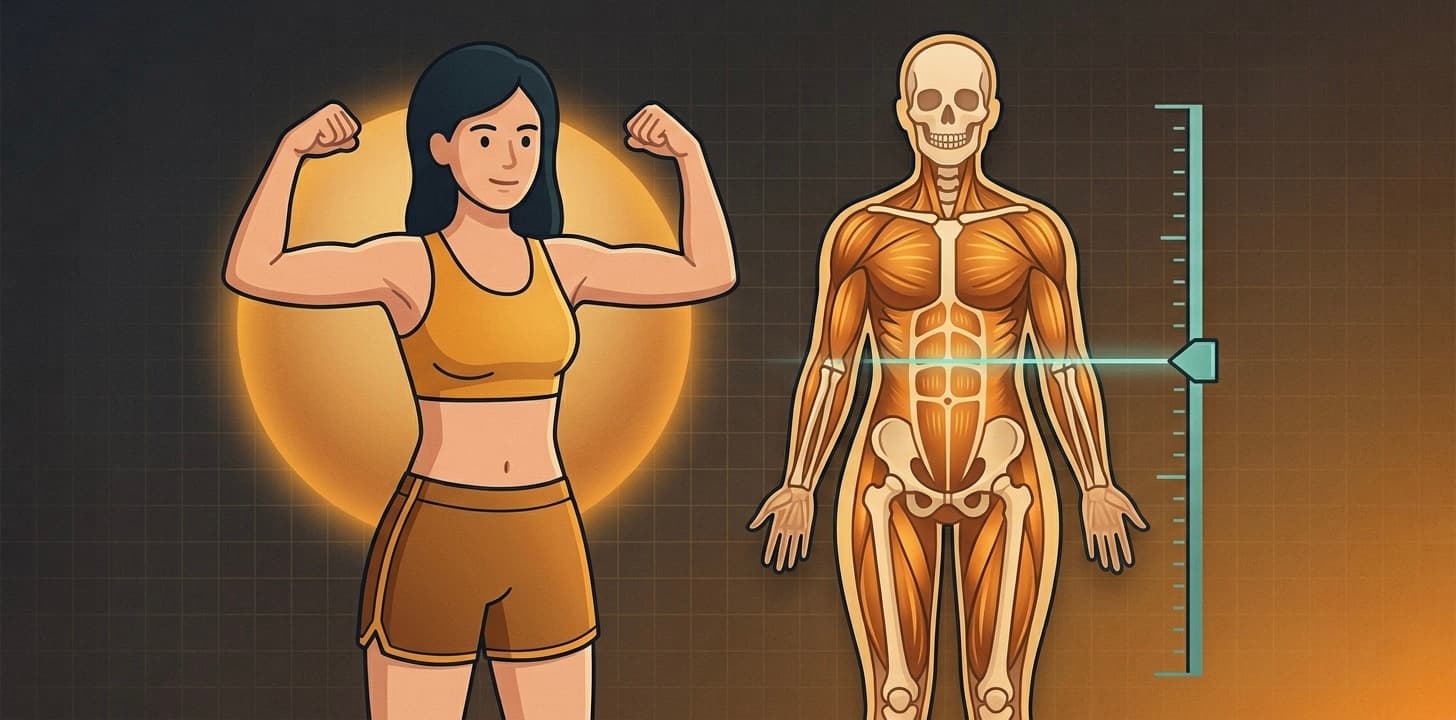
What remains after you subtract fat mass is called fat-free mass (FFM): your muscles, bones, organs, water, and connective tissue. Understanding the relationship between these two compartments is the foundation of body composition analysis.
Why Body Fat Percentage Matters More Than Scale Weight
Two people can weigh 180 lbs and look completely different. Person A carries 25 lbs of fat (13.9% body fat) and 155 lbs of lean mass. Person B carries 55 lbs of fat (30.6% body fat) and 125 lbs of lean mass. The scale sees them as identical. Body fat percentage reveals the truth.
This is also why BMI is a deeply flawed metric. BMI divides weight by height squared and ignores composition entirely. A muscular 5'10" athlete at 200 lbs registers as "overweight" despite being lean and metabolically healthy.
Body fat percentage matters for three practical reasons:
- Health risk assessment. Visceral fat, the fat surrounding your organs, is strongly correlated with cardiovascular disease, type 2 diabetes, and metabolic syndrome. Men above 25% and women above 35% body fat enter elevated risk territory.
- Training progress. If you gain 5 lbs over three months, knowing whether that was 5 lbs of muscle versus 5 lbs of fat determines whether your program is working.
- Nutritional calibration. Your total daily energy expenditure (TDEE) depends partly on lean mass. Knowing your body fat percentage lets you set caloric targets more precisely.
Healthy Body Fat Ranges
Body fat norms differ by gender because women carry essential fat in breast tissue, hips, and reproductive organs. Here are evidence-based ranges:
Men
| Category | Body Fat % |
|---|---|
| Essential fat | 2-5% |
| Competition lean | 5-8% |
| Athletic | 8-13% |
| Fit | 14-17% |
| Average | 18-24% |
| Above average | 25%+ |
Women
| Category | Body Fat % |
|---|---|
| Essential fat | 10-13% |
| Competition lean | 14-18% |
| Athletic | 18-22% |
| Fit | 23-28% |
| Average | 29-35% |
| Above average | 36%+ |
Essential fat is the minimum required for normal physiological function. Going below these thresholds, which some bodybuilders do for competition, is not sustainable and carries real health risks including hormonal disruption, immune suppression, and bone density loss.
The 5 Methods for Measuring Body Fat
1. DEXA Scan (Dual-Energy X-Ray Absorptiometry)
How it works: A low-dose X-ray beam at two energy levels passes through your body. Different tissues (bone, lean, fat) attenuate the beams differently, and software reconstructs a full-body composition map.
Accuracy: +/- 1-2% body fat. DEXA is widely considered the clinical gold standard for non-laboratory settings.
Cost: $75-150 per scan at most facilities.
Pros:
- Gives regional data (you can see fat distribution by limb and trunk)
- Measures bone mineral density simultaneously
- Highly reproducible when using the same machine and technician
Cons:
- Hydration status can shift results by 1-2%
- Different DEXA manufacturers (Hologic vs. GE Lunar) use different algorithms and produce systematically different numbers
- Not portable: requires a clinical visit
Best practice: Get scanned at the same facility, same time of day, in a fasted and normally hydrated state. Compare only to your own previous scans on the same machine.
2. Skinfold Calipers
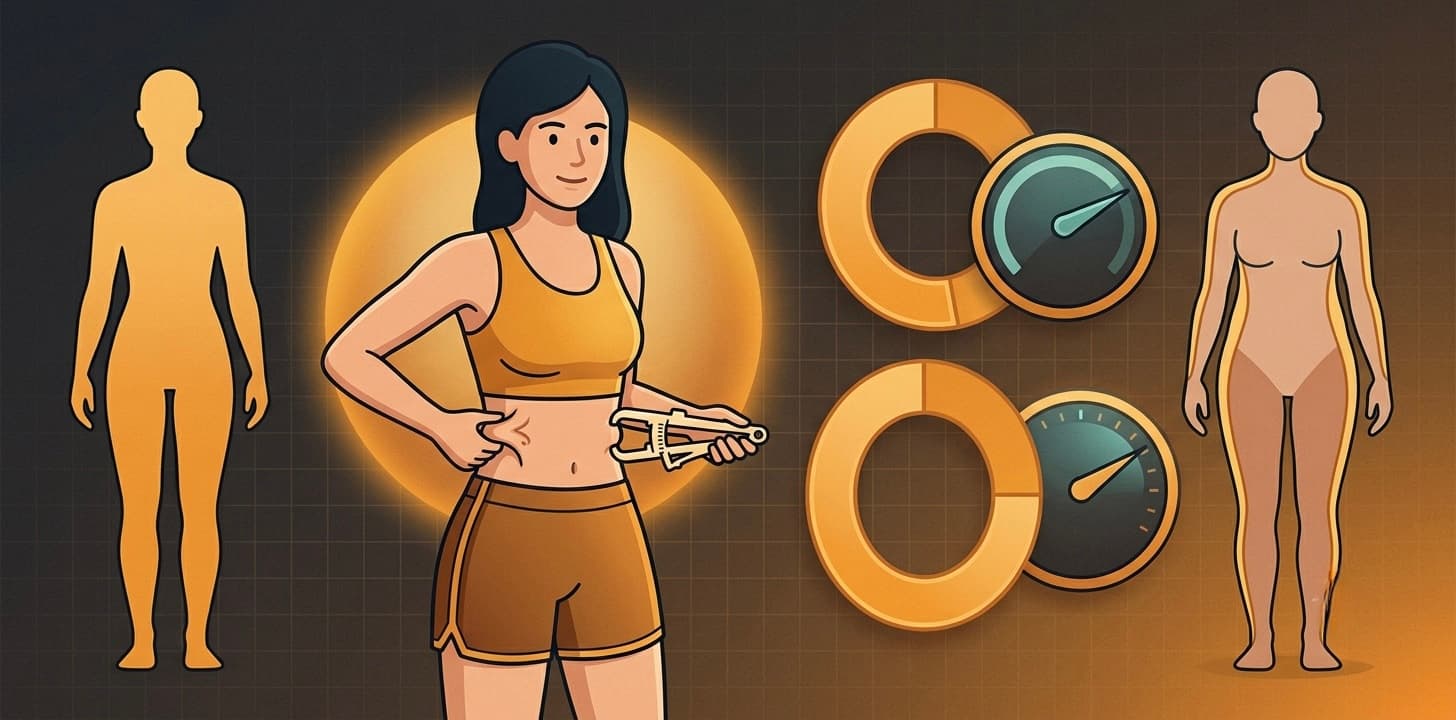
How it works: A trained technician pinches folds of skin and subcutaneous fat at specific anatomical sites (typically 3, 4, or 7 sites) and measures the fold thickness in millimeters. The measurements are plugged into population-specific equations, the Jackson-Pollock 3-site and 7-site formulas are the most common, to estimate body fat.
Accuracy: +/- 3-5% body fat depending on technician skill.
Cost: $10-30 for calipers; free if a trainer measures you.
The Jackson-Pollock 3-Site Formula (Men):
- Sites: chest, abdomen, thigh
- Body Density = 1.10938 - (0.0008267 x sum of 3 skinfolds) + (0.0000016 x sum of 3 skinfolds squared) - (0.0002574 x age)
- Body Fat % = (495 / Body Density) - 450
Pros:
- Cheap, portable, repeatable
- Good for tracking change over time (even if absolute accuracy is limited)
Cons:
- Highly operator-dependent: the same person measured by two different technicians can get results 3-4% apart
- Less accurate for very lean or very overweight individuals
- Only measures subcutaneous fat (misses visceral fat entirely)
3. Bioelectrical Impedance Analysis (BIA)
How it works: A small electrical current (usually 50 kHz) is sent through your body. Fat conducts electricity poorly; lean tissue, which contains more water and electrolytes, conducts well. The device measures impedance (resistance) and uses equations to estimate fat mass.
Accuracy: +/- 3-8% body fat. Consumer devices (smart scales, handheld analyzers) are at the high end of that error range. Medical-grade multi-frequency devices are more reliable.
Cost: $20-200 for consumer devices; $50-100 per session for clinical-grade.
Pros:
- Fast (under 30 seconds)
- Available at home via smart scales
- No special skill required
Cons:
- Extremely sensitive to hydration. Drinking 2-3 glasses of water before testing can shift results by 3-5%.
- Algorithms are proprietary and vary wildly between manufacturers
- Foot-to-foot scales only measure the lower body path; hand-to-foot devices are more accurate
4. The Navy Method (Circumference-Based)
How it works: Using a tape measure, you take specific circumference measurements and plug them into equations developed by the U.S. Navy.
For men:
- Measure: neck and waist (at navel)
- Body Fat % = 86.010 x log10(waist - neck) - 70.041 x log10(height) + 36.76
- All measurements in inches
For women:
- Measure: neck, waist, and hips
- Body Fat % = 163.205 x log10(waist + hip - neck) - 97.684 x log10(height) - 78.387
Accuracy: +/- 3-5% body fat. Comparable to calipers in most studies.
Pros:
- Free, requires only a tape measure
- Reproducible if you measure at consistent landmarks
- No special equipment or training
Cons:
- Less accurate for very muscular individuals (large neck circumference skews results)
- Doesn't capture limb fat well
- Population-specific: the equations were developed on military populations
5. Visual Estimation
How it works: You compare your physique to reference photos at known body fat percentages.
Accuracy: +/- 5-8%. Subjective and influenced by muscle mass, lighting, and personal bias.
This method is free and instant, but unreliable for anything other than a rough ballpark. A person with significant muscle mass will look leaner at the same body fat percentage than someone with less muscle, making visual comparison misleading.
Accuracy Comparison at a Glance
| Method | Error Range | Cost | Accessibility |
|---|---|---|---|
| DEXA | +/- 1-2% | $75-150 | Clinical facility |
| Calipers | +/- 3-5% | $10-30 | Gym / self |
| BIA (clinical) | +/- 3-5% | $50-100 | Clinical facility |
| BIA (consumer) | +/- 4-8% | $20-200 | Home |
| Navy Method | +/- 3-5% | Free | Home |
| Visual | +/- 5-8% | Free | Anywhere |
The Most Important Principle: Consistency Over Accuracy
Here is the thing most people miss: the absolute number matters less than the trend. If your BIA scale says you are 22% body fat and a DEXA says you are 19%, that does not matter much, as long as you use the same method every time and track the direction.
Pick one method. Use it under the same conditions every time. Measure every 2-4 weeks. The trajectory is what tells you whether your nutrition and training are working.
What to Do With Your Number
Once you know your body fat percentage, you can make sharper decisions:
- Cutting (fat loss): If you are above your target range, aim to lose 0.5-1% body fat per month. Faster rates risk muscle loss. A caloric deficit of 300-500 calories below your TDEE, combined with resistance training and adequate protein (0.7-1g per pound of body weight), is the standard approach.
- Bulking (muscle gain): If you are lean and want to add muscle, expect body fat to rise 1-3% over a 3-4 month gaining phase. Keeping fat gain in check requires a moderate surplus of 200-350 calories and progressive overload in your training.
- Maintenance: If you are in your target range, periodic body fat checks every 4-8 weeks ensure you are not drifting.
Common Mistakes
- Comparing numbers across methods. A DEXA reading and a BIA reading are not interchangeable. Stick to one.
- Measuring too frequently. Body fat does not change meaningfully day-to-day. Every 2-4 weeks is sufficient.
- Ignoring conditions. Hydration, meal timing, and even glycogen levels affect measurements. Standardize your testing conditions.
- Chasing an arbitrary number. A body fat percentage that looks good on paper but requires extreme restriction is not a health goal. Find the range where you perform well, feel good, and can sustain your habits.
Your body fat percentage is a tool, not a verdict. Use it to make informed decisions about your training and nutrition, track it consistently, and let the trend guide your adjustments.