BMI Is Broken: Why You Need Better Metrics for Body Composition
8 min read · April 2025 · by Manikanta Sirumalla
BMI Is Broken: Why You Need Better Metrics for Body Composition
In 1832, a Belgian astronomer and mathematician named Lambert Adolphe Jacques Quetelet divided body weight in kilograms by height in meters squared and called it the "Quetelet Index." He was not a physician. He was not studying health. He was trying to describe the proportions of the "average man" across large populations for social statistics. Nearly two centuries later, that exact same formula, renamed Body Mass Index in 1972 by physiologist Ancel Keys, is still the primary tool doctors use to classify your body. A formula designed for 19th-century population averages is being applied to individual human beings in 2025. That is the first problem. It is not the last.
What BMI Actually Is (And What It Was Designed For)
The BMI formula is almost comically simple:
BMI = Weight (kg) / Height (m)^2
Or in imperial units:
BMI = (Weight (lbs) x 703) / Height (inches)^2
A 5'10" person weighing 180 lbs has a BMI of 25.8: officially "overweight" according to the World Health Organization. The classification brackets look like this:
| BMI Range | Classification |
|---|---|
| Under 18.5 | Underweight |
| 18.5 - 24.9 | Normal weight |
| 25.0 - 29.9 | Overweight |
| 30.0 - 34.9 | Obese (Class I) |
| 35.0 - 39.9 | Obese (Class II) |
| 40.0+ | Obese (Class III) |
Quetelet designed this index to study populations, not individuals. He explicitly stated that applying it to a single person was a misuse of the tool. His goal was to find the statistical distribution of body sizes across thousands of people for sociological research. He never intended it as a health screening tool.
Keys, who popularized the term "Body Mass Index" 140 years later, tested it against actual body fat measurements and found that BMI explained only about 50-70% of the variance in body fat across individuals. That means 30-50% of what makes your body composition unique is invisible to BMI. He noted it was the best simple alternative, not that it was good. The medical system adopted it because it required nothing more than a scale and a tape measure. Convenience won over accuracy.
Five Reasons BMI Fails Individuals
1. It Cannot Distinguish Muscle From Fat
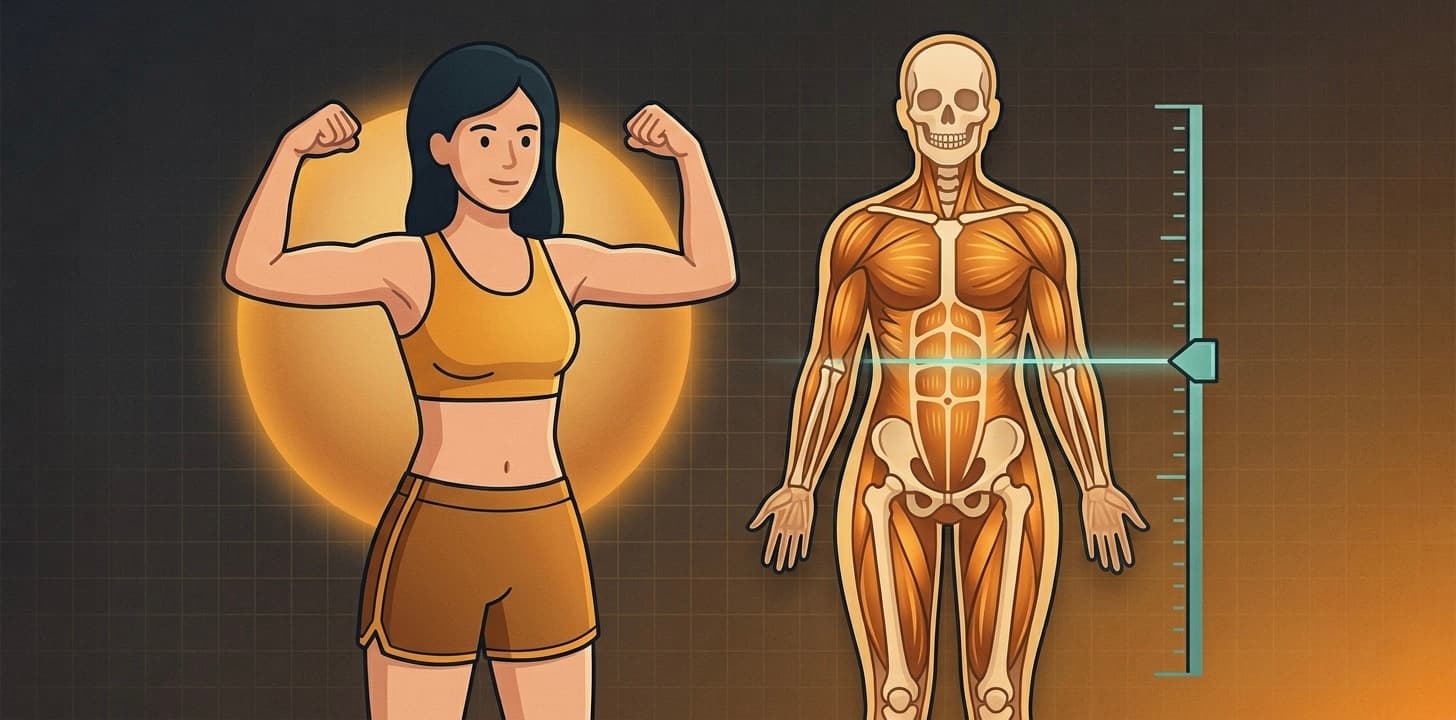
This is the most well-known flaw and the most damaging. BMI treats all weight equally. A kilogram of muscle and a kilogram of fat contribute identically to the calculation, despite being completely different tissues with different metabolic profiles, health implications, and visual appearance.
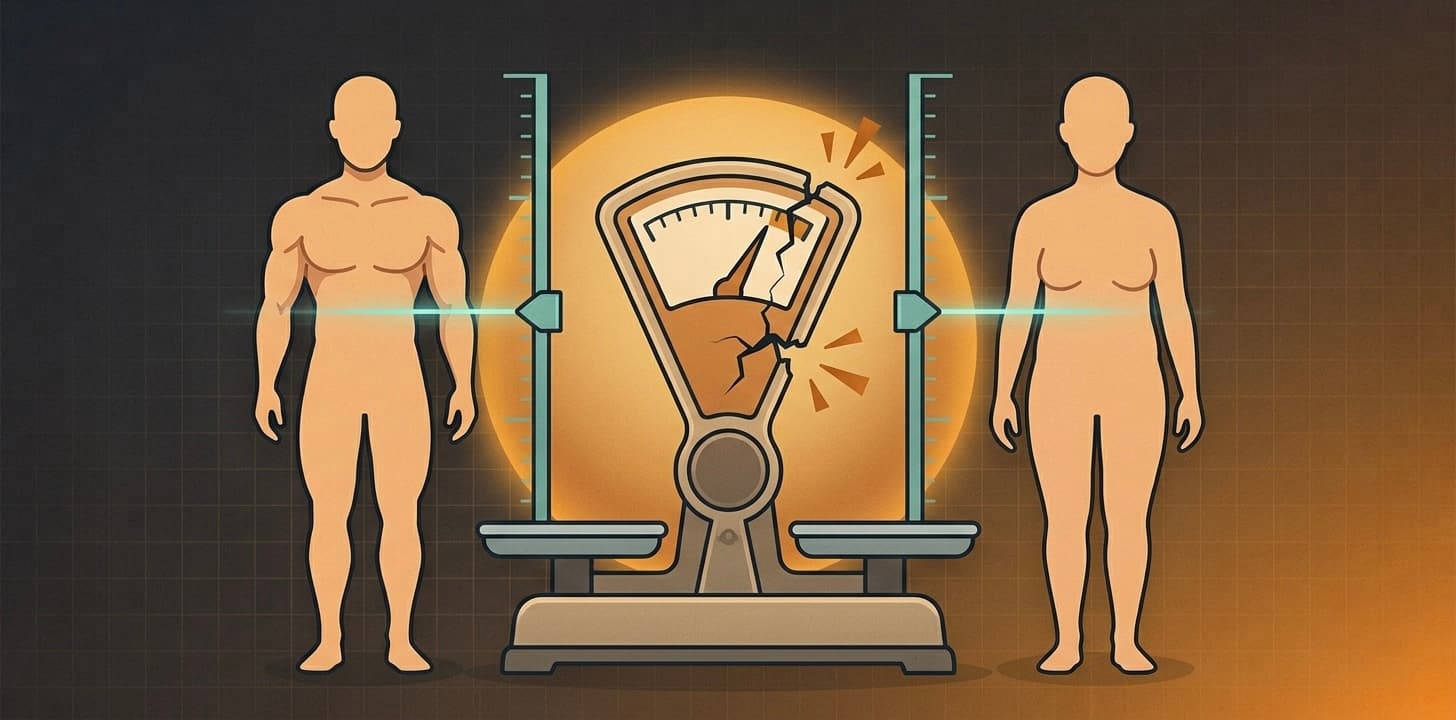
Consider two men, both 5'10" and 210 lbs. Their BMI is identical: 30.1, clinically "obese." Person A is a strength athlete at 15% body fat carrying 178.5 lbs of lean mass. Person B is sedentary at 32% body fat carrying 142.8 lbs of lean mass. One is metabolically healthy with excellent cardiovascular markers. The other is at elevated risk for type 2 diabetes, cardiovascular disease, and metabolic syndrome. BMI sees them as the same person.
A 2016 UCLA study analyzing data from the National Health and Nutrition Examination Survey found that 54 million Americans classified as "overweight" or "obese" by BMI were actually metabolically healthy based on blood pressure, cholesterol, blood glucose, triglycerides, and C-reactive protein levels. That is roughly 47% of people in the "overweight" BMI bracket being misclassified.
2. It Ignores Fat Distribution
Where you carry fat matters enormously for health risk. Visceral fat (the fat surrounding your abdominal organs) is far more metabolically dangerous than subcutaneous fat on your hips and thighs. Two people with identical BMIs and even identical body fat percentages can have dramatically different health risk profiles depending on where that fat sits.
A person carrying excess fat around their midsection (an "apple" shape) faces significantly higher risks of cardiovascular disease, insulin resistance, and inflammatory conditions than someone carrying fat in their lower body (a "pear" shape). BMI captures none of this. A waist circumference measurement takes 10 seconds and provides more actionable health data than BMI does.
3. It Has No Age Adjustment
Body composition shifts with age even when weight remains stable. After age 30, adults lose approximately 3-8% of muscle mass per decade through a process called sarcopenia, while fat mass tends to increase. A 60-year-old and a 25-year-old can have identical BMIs while the older individual carries significantly more fat and less muscle. The health implications are completely different, but BMI treats them identically.
4. Its Gender Correction Is Absent
Women naturally carry more essential body fat than men: roughly 10-13% essential fat for women versus 2-5% for men. Women also have different fat distribution patterns due to estrogen's influence on adipose tissue storage. Despite these fundamental biological differences, BMI uses the same formula and the same classification cutoffs for both genders.
5. It Penalizes Short People and Flatters Tall People
Because BMI divides by height squared rather than height cubed, it systematically overestimates fatness in short people and underestimates it in tall people. Oxford mathematician Nick Trefethen demonstrated this bias and proposed a corrected formula, BMI = 1.3 x weight (kg) / height (m)^2.5, but the medical establishment has been slow to adopt it. A 5'2" muscular woman is more likely to be flagged as "overweight" than a 6'2" man with the same relative body composition.
When BMI Actually Works
Despite its limitations, BMI is not completely useless. Dismissing it entirely goes too far. It has legitimate applications in specific contexts.
Large-scale population health screening. When public health researchers need to assess obesity trends across millions of people, BMI works well enough. Individual errors average out over large samples. The correlation between BMI and body fat percentage at the population level is roughly 0.7-0.8, which is adequate for epidemiological research.
Sedentary individuals without significant muscle mass. For people who do not engage in resistance training and have average body compositions, BMI categories align reasonably well with body fat ranges. The "normal" BMI bracket roughly corresponds to healthy body fat levels in this specific population.
Initial triage in clinical settings. BMI can flag individuals who may benefit from further assessment. A BMI of 38 almost certainly indicates excess body fat regardless of muscle mass. It is a starting point, not a conclusion.
Tracking general trends over time. If you are sedentary, not building muscle, and tracking your BMI over months or years, a declining BMI probably reflects fat loss. The directional signal has value even when the absolute classification does not.
The problem is not that BMI exists. The problem is that it is used as a diagnostic tool for individuals when it was designed as a statistical tool for populations.
Better Alternatives to BMI
Body Fat Percentage
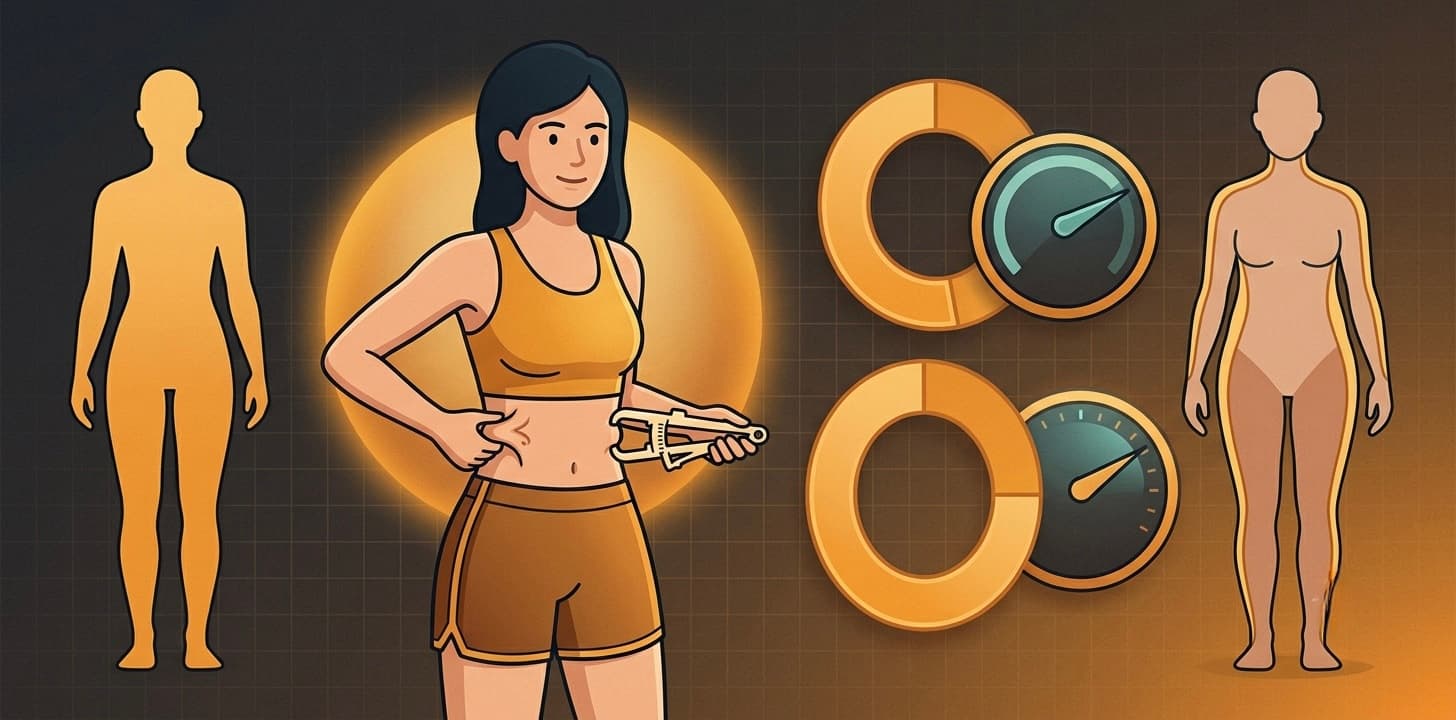
The single best replacement for BMI. Body fat percentage directly measures what BMI tries to estimate: how much of your mass is fat versus lean tissue. Methods range from DEXA scans (accurate to +/- 1-2%) to the Navy circumference method (accurate to +/- 3-5%) to bioelectrical impedance scales (accurate to +/- 4-8%). Even the least accurate method provides more useful information than BMI.
Waist-to-Hip Ratio (WHR)
Divide your waist circumference (measured at the narrowest point above the navel) by your hip circumference (measured at the widest point of the buttocks). WHR captures fat distribution, which BMI completely ignores.
| Risk Level | Men | Women |
|---|---|---|
| Low | Under 0.90 | Under 0.80 |
| Moderate | 0.90 - 0.99 | 0.80 - 0.85 |
| High | 1.00+ | 0.86+ |
WHR is particularly valuable because it correlates strongly with visceral fat: the metabolically dangerous fat that drives cardiovascular and metabolic disease.
Waist Circumference Alone
Sometimes the simplest metric is the most practical. A waist circumference above 40 inches for men or above 35 inches for women is associated with significantly elevated health risks, regardless of overall body weight. This single measurement is a better predictor of cardiovascular disease risk than BMI in most studies.
Lean-to-Fat Ratio
Divide your fat-free mass by your fat mass. This gives you a single number that captures the balance between muscle and fat in your body. A lean-to-fat ratio of 5:1 (meaning five pounds of lean mass for every pound of fat) indicates a very different body than a ratio of 2:1, even if both people have the same BMI.
The Multi-Metric Approach
No single number tells the full story. The best approach combines several metrics into a composite picture.
| Metric | What It Tells You | How to Get It |
|---|---|---|
| Body Fat % | Overall fat vs. lean | DEXA, calipers, Navy method, BIA |
| Waist Circumference | Central obesity risk | Tape measure |
| Waist-to-Hip Ratio | Fat distribution pattern | Tape measure |
| Lean-to-Fat Ratio | Muscle vs. fat balance | Calculated from body fat % |
| BMI | Population-level weight status | Scale + tape measure |
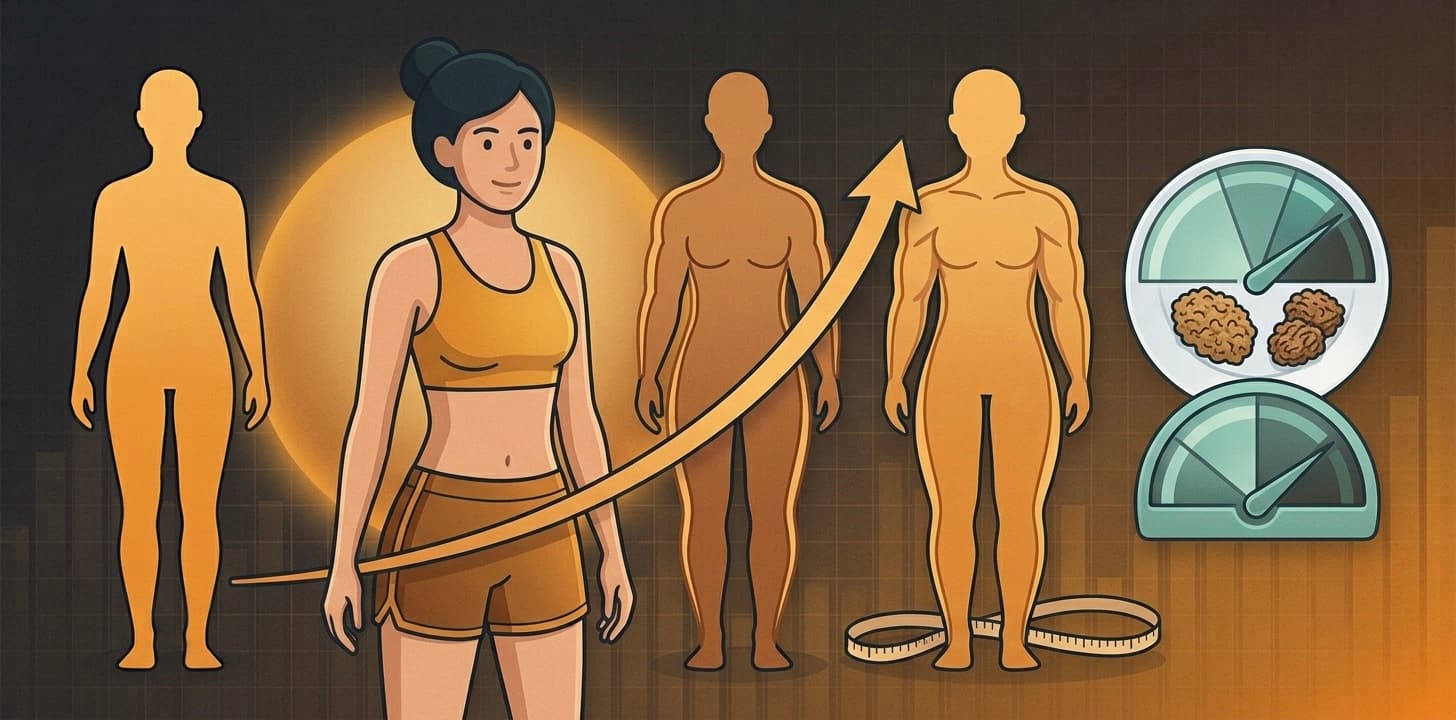
When you track all five, you get a body composition profile that is orders of magnitude more informative than BMI alone. Trends across these metrics over 4-8 weeks reveal whether your training and nutrition are actually moving your body in the right direction.
What To Track Instead of Obsessing Over BMI
If you are training regularly (which, if you are reading this, you probably are), BMI tells you almost nothing useful. Here is a practical tracking protocol that actually works:
Every 2 weeks: Measure waist circumference and hip circumference. Calculate WHR. Log your weight. If you use a BIA scale, record the body fat reading (under consistent conditions: same time, fasted, after using the bathroom).
Every 4-8 weeks: Get a more formal body composition assessment. DEXA if accessible, calipers or Navy method if not. Update your lean mass and fat mass figures.
Every day (optional): Weigh yourself first thing in the morning and use a 7-day rolling average to smooth out fluctuations. The daily number is noise. The weekly average is signal.
The goal is not to replace one obsessive metric with five obsessive metrics. It is to build a multidimensional understanding of your body that informs real decisions: whether to keep cutting, when to start a lean bulk, whether your training is actually producing the adaptations you want.
Your body is more complex than a ratio of weight to height. Measure it that way.