Supersets, Drop Sets, and Giant Sets: When to Use Each One
8 min read · April 2025 · by Manikanta Sirumalla
Supersets, Drop Sets, and Giant Sets: When to Use Each One
A standard set of barbell curls (3 sets of 10, 90 seconds rest between each) takes about 6 minutes. The same volume organized as a superset with tricep pushdowns takes roughly 4 minutes and produces a stronger metabolic stimulus. That 33% time savings compounds across an entire workout. A 60-minute session becomes 40 minutes with the same or greater training effect.
But here is where most people go wrong: they apply these techniques indiscriminately. They superset heavy squats with heavy Romanian deadlifts and wonder why their performance craters. They run drop sets on their first exercise when they still have 45 minutes of training ahead. They string together giant sets of random exercises and call it "intensity."
Advanced set techniques are tools with specific use cases. Use the right one at the right time and you accelerate progress. Use the wrong one and you accumulate junk volume: sets that create fatigue without producing a meaningful growth stimulus.
Definitions: What Each Technique Actually Is
Before programming these techniques, you need precise definitions. The terms get thrown around loosely in most gyms.
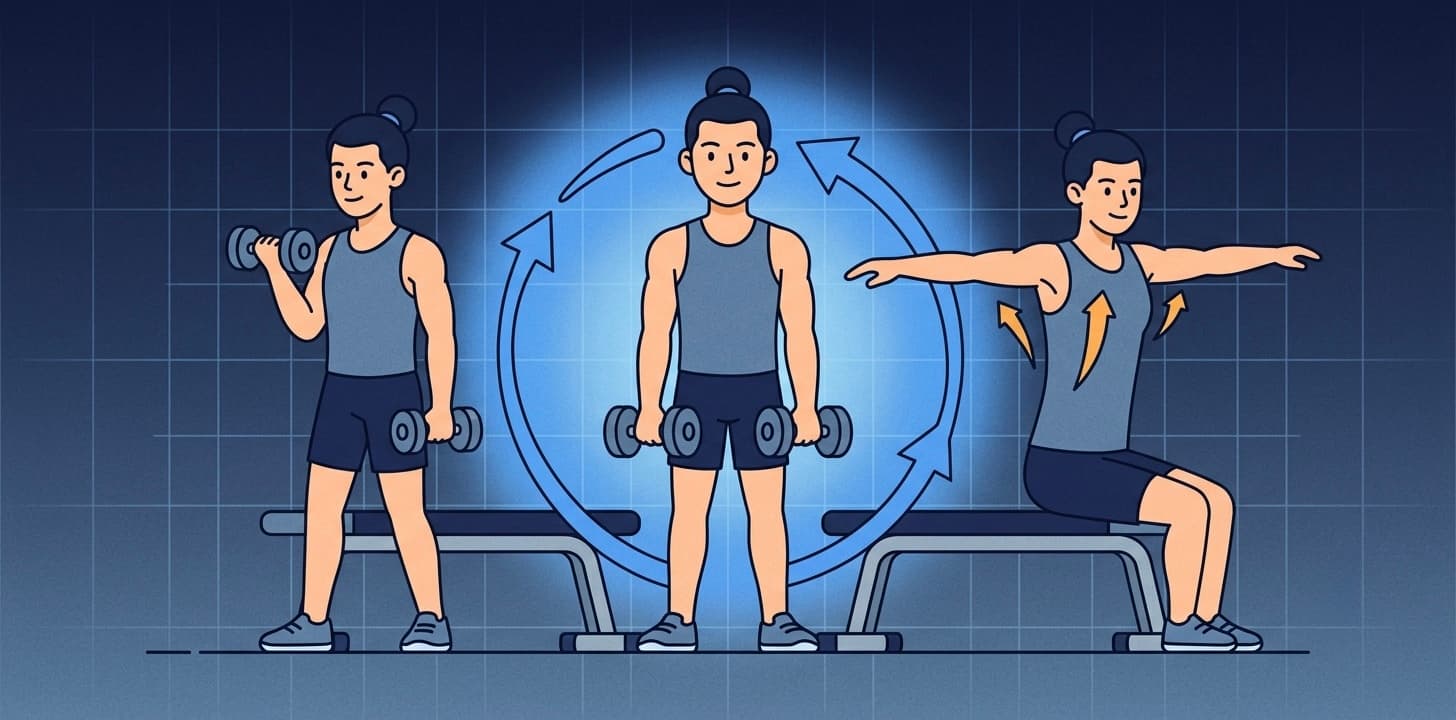
Superset: Two exercises performed back-to-back with no rest between them. You complete one set of exercise A, immediately perform one set of exercise B, then rest before repeating. There are two subtypes:
- Antagonist supersets pair opposing muscle groups: bicep curls with tricep pushdowns, bench press with barbell rows, leg extensions with leg curls. Because the working muscles of exercise A are resting during exercise B, performance on both exercises remains relatively high.
- Agonist supersets (sometimes called compound sets) pair exercises that target the same muscle group: bench press with dumbbell flyes, squats with leg press. These are significantly more fatiguing because the target muscle never gets a break.
Drop set: A single extended set where you reduce the weight and continue repping immediately, without rest. You perform your set to near-failure, strip 20-30% of the weight, and rep out again. Some lifters do two or three drops in a row: these are called double or triple drop sets. The entire sequence counts as one set.
Giant set: Three or more exercises performed consecutively with no rest between them. A giant set for shoulders might look like: lateral raises, overhead press, face pulls, and front raises, all back-to-back before resting. Giant sets are the most metabolically demanding technique of the three and the most likely to compromise performance if misused.
When to Use Each Technique
Each technique solves a different problem. The key is matching the tool to the goal.
Supersets: Time Efficiency and Volume Accumulation
Antagonist supersets are the most broadly useful advanced technique. Research published in the Journal of Strength and Conditioning Research found that antagonist supersets reduced total workout time by 33-40% compared to traditional sets while producing equivalent strength and hypertrophy gains. In some studies, performance on the second exercise actually improved due to reciprocal inhibition: the contraction of the antagonist muscle facilitates greater activation of the agonist.
Best use cases:
- You are pressed for time and need to maintain total volume
- You want to increase training density (more work per unit of time)
- You are pairing compound exercises from opposing movement patterns (push/pull)
- You are in an accumulation or hypertrophy phase where moderate loads and higher volume are the priority
Best pairings:
- Bench press + barbell row
- Bicep curls + tricep pushdowns
- Leg extensions + leg curls
- Overhead press + pull-ups
- Chest flyes + reverse flyes
Agonist supersets are more specialized. They are essentially a pre-exhaust or post-exhaust technique: pairing a compound with an isolation for the same muscle group. Use these when a muscle group is lagging and you want to push it beyond what a standard set can achieve.
Drop Sets: Hypertrophy and Metabolic Stress
Drop sets extend time under tension far beyond what a single straight set allows. A standard set of 10 reps at an RPE 9 might last 25-30 seconds. Add two drops and that same set becomes 50-70 seconds of continuous work. This prolonged tension increases metabolite accumulation: hydrogen ions, lactate, and other byproducts that contribute to the metabolic stress pathway of hypertrophy.
A 2018 meta-analysis in Sports Medicine found that drop sets produced equivalent hypertrophy to traditional multi-set training in significantly less time. The catch: they generate substantially more fatigue per set. One drop set can create as much systemic fatigue as two or three straight sets.
Best use cases:
- The last 1-2 sets of an isolation exercise (lateral raises, curls, leg extensions)
- When you want to push a muscle group to complete failure safely
- During a hypertrophy phase where metabolic stress is a priority
- When training time is extremely limited and you need maximum stimulus per set
Programming rules:
- Use drop sets on the last exercise for a muscle group, not the first
- Reduce weight by 20-30% per drop (e.g., 100 lbs to 75 lbs to 55 lbs)
- Limit to 2-3 drops per set: beyond that, the weight is so light that the stimulus is minimal
- Cap drop sets at 1-2 per workout to avoid excessive fatigue accumulation
Giant Sets: Conditioning and Metabolic Work
Giant sets are the nuclear option. Three to five exercises back-to-back with no rest creates an enormous cardiovascular and metabolic demand. Heart rate spikes to 80-90% of max, caloric expenditure per minute roughly doubles compared to traditional training, and the pump is extraordinary.
Best use cases:
- Conditioning phases or fat-loss training blocks
- Muscle groups with multiple heads or functions (shoulders, back)
- Finisher circuits at the end of a workout
- When gym time is severely limited (under 30 minutes)
Best exercise choices for giant sets:
- Machines and cables (easy to transition, stable movement patterns)
- Bodyweight exercises (no equipment setup time)
- Light dumbbells (quick to grab and swap)
- Avoid heavy barbell compounds: fatigue accumulation makes form breakdown nearly inevitable by the third or fourth exercise
Comparison Table
| Feature | Superset | Drop Set | Giant Set |
|---|---|---|---|
| Exercises | 2 | 1 (with weight reductions) | 3-5 |
| Rest between exercises | None | None (weight change only) | None |
| Rest between rounds | 60-120 sec | 90-180 sec | 120-180 sec |
| Primary benefit | Time efficiency | Hypertrophy / metabolic stress | Conditioning / volume |
| Fatigue cost | Moderate | High | Very high |
| Best placement | Anywhere in workout | Last exercise for muscle group | End of workout or dedicated session |
| Best equipment | Any | Machines, cables | Machines, cables, bodyweight |
| Ideal rep range | 6-15 per exercise | 8-12 per drop | 10-15 per exercise |
Fatigue Management: The Critical Detail
These techniques share one trait: they all generate more fatigue per unit of time than straight sets. That fatigue has to be accounted for in your weekly programming, or you will dig a recovery hole that straight sleep and protein cannot fill.
Here is a practical framework. Think of your weekly training in terms of a fatigue budget. Straight sets are the baseline. Each advanced technique "costs" more than a standard set:
- 1 antagonist superset round equals approximately 1.2-1.5 straight sets of fatigue
- 1 agonist superset round equals approximately 1.8-2.0 straight sets of fatigue
- 1 drop set (with 2 drops) equals approximately 2.5-3.0 straight sets of fatigue
- 1 giant set round equals approximately 3.0-4.0 straight sets of fatigue
If your maximum recoverable volume for chest is 20 sets per week, and you do 4 drop sets, those "cost" roughly 10-12 sets of your fatigue budget: leaving room for only 8-10 more straight sets. Fail to account for this and you will overshoot your recoverable volume, stall, and potentially need an unplanned deload.
This is why progressive overload tracking matters even more when using advanced techniques. You need data to know whether the added intensity is producing results or just producing fatigue. If your weights are going up and RPE is stable, the technique is working. If your RPE is climbing while weights stagnate, you are likely over-fatigued.
How to Log These Properly
The biggest practical challenge with advanced set techniques is tracking them. A standard set is simple: exercise, weight, reps. A drop set with three drops has three different weights and three different rep counts within a single "set." A superset has two exercises interleaved. If your log does not capture this structure, you lose the data, and without data, you cannot progressively overload.
For supersets, you need to log both exercises and mark them as paired. The rest period belongs to the pair, not the individual exercises. For drop sets, each drop should show its own weight and rep count, but the entire sequence is one set: not three separate sets. For giant sets, all three to five exercises need to be grouped with a single rest period at the end.
Here is what to record for each type:
Superset log entry:
- Exercise A: weight, reps, RPE
- Exercise B: weight, reps, RPE
- Rest period after the pair
- Mark: "superset" or "SS"
Drop set log entry:
- Starting weight and reps (e.g., 100 lbs x 10)
- Drop 1: weight and reps (e.g., 75 lbs x 8)
- Drop 2: weight and reps (e.g., 55 lbs x 6)
- Total set RPE (should be 10: drop sets are taken to failure by definition)
Giant set log entry:
- Each exercise: weight, reps
- Rest period after the full circuit
- Round number (giant sets are typically done for 2-4 rounds)
Over time, this data reveals patterns. You will see whether your drop set rep counts are improving (a sign of increased muscular endurance and work capacity), whether your superset performance holds steady across rounds, and whether giant set conditioning is progressing.
A Sensible Starting Point
If you have never used these techniques, do not add all three at once. Start with antagonist supersets: they are the lowest-risk, highest-reward option. Pair your existing exercises and observe the time savings and performance impact over 2-3 weeks. Once comfortable, introduce one drop set at the end of your last isolation exercise. Giant sets come last, and only if your goals specifically call for conditioning work.
The goal is always the same: more productive training stimulus in less time, with fatigue you can recover from. When you overshoot on intensity techniques, you get the opposite: more fatigue than stimulus, stalled progress, and workouts that leave you wrecked instead of stimulated. Start conservative. Let the data tell you when to push harder.