Push Pull Legs: The Complete Program Guide
10 min read · April 2025 · by Manikanta Sirumalla
Push Pull Legs: The Complete Program Guide
If you have been training for at least six months and can commit to the gym five or six days per week, the Push Pull Legs (PPL) split is probably the single most effective way to organize your training. It groups muscles by movement function, hits every body part twice per week, and scales cleanly from intermediate to advanced. This guide walks through exactly how to build one from scratch.
What Is a Push Pull Legs Split?
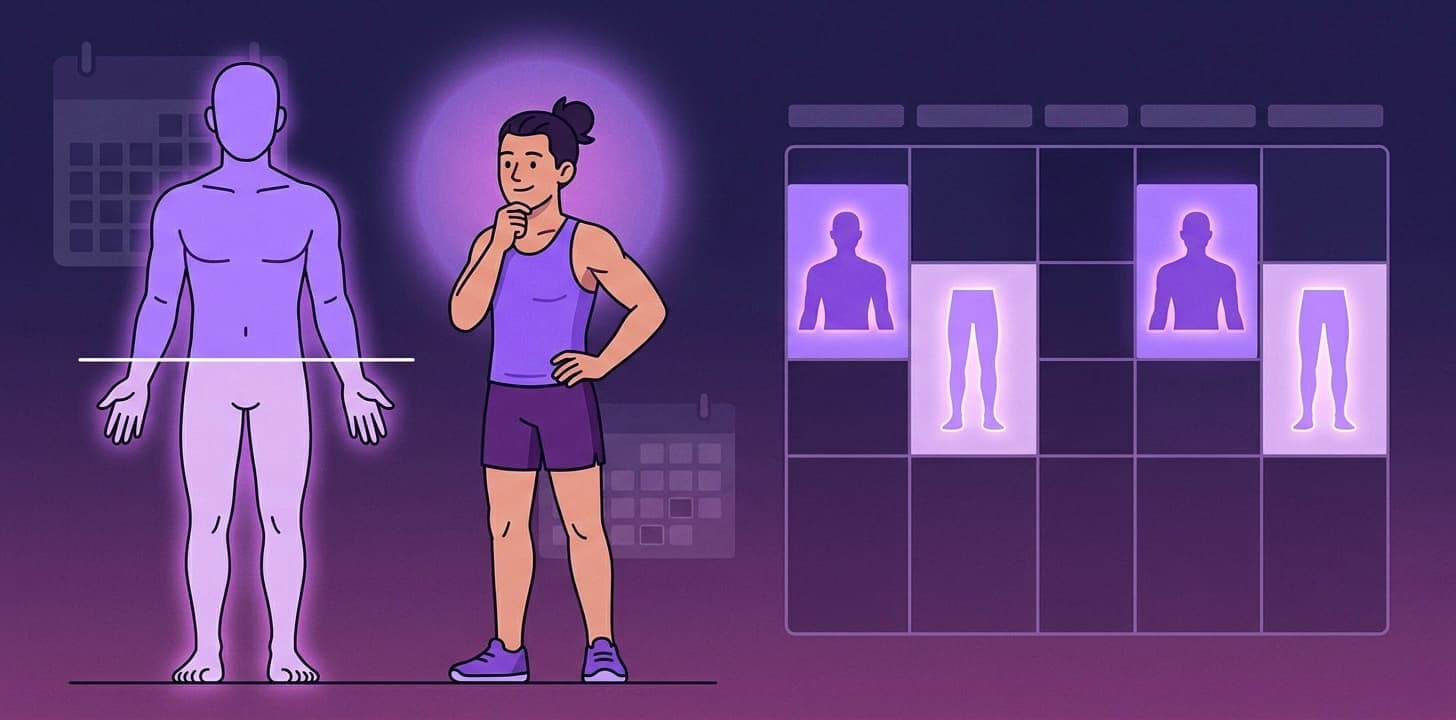
PPL divides your training week into three workout categories based on the primary movement pattern:
- Push: any exercise where you press a load away from your torso. This trains the chest, anterior and lateral deltoids, and triceps.
- Pull: any exercise where you pull a load toward your torso. This trains the upper and lower back, rear deltoids, and biceps.
- Legs: squats, hinges, and all lower-body work. This covers quadriceps, hamstrings, glutes, adductors, and calves.
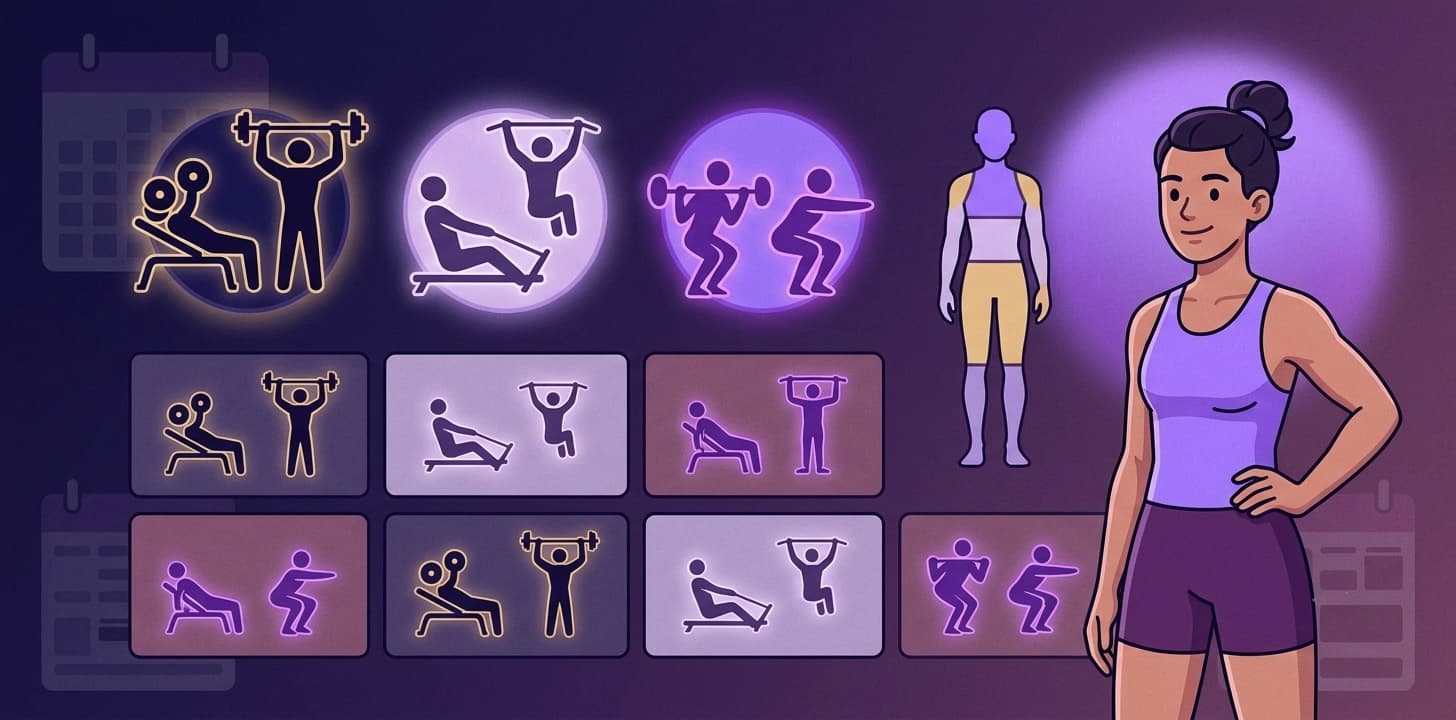
You run through the three-day cycle, rest, and repeat. A standard week looks like this:
| Day | Session | Primary Muscles |
|---|---|---|
| Monday | Push A | Chest, shoulders, triceps |
| Tuesday | Pull A | Back, biceps, rear delts |
| Wednesday | Legs A | Quads, hamstrings, glutes |
| Thursday | Push B | Chest, shoulders, triceps |
| Friday | Pull B | Back, biceps, rear delts |
| Saturday | Legs B | Quads, hamstrings, glutes |
| Sunday | Rest | - |
The A/B distinction matters. You are not copying the same workout twice: you are varying exercise selection, rep ranges, and intensity between the two sessions. More on that below.
Who Should Run PPL?
PPL works best for lifters who meet two criteria:
-
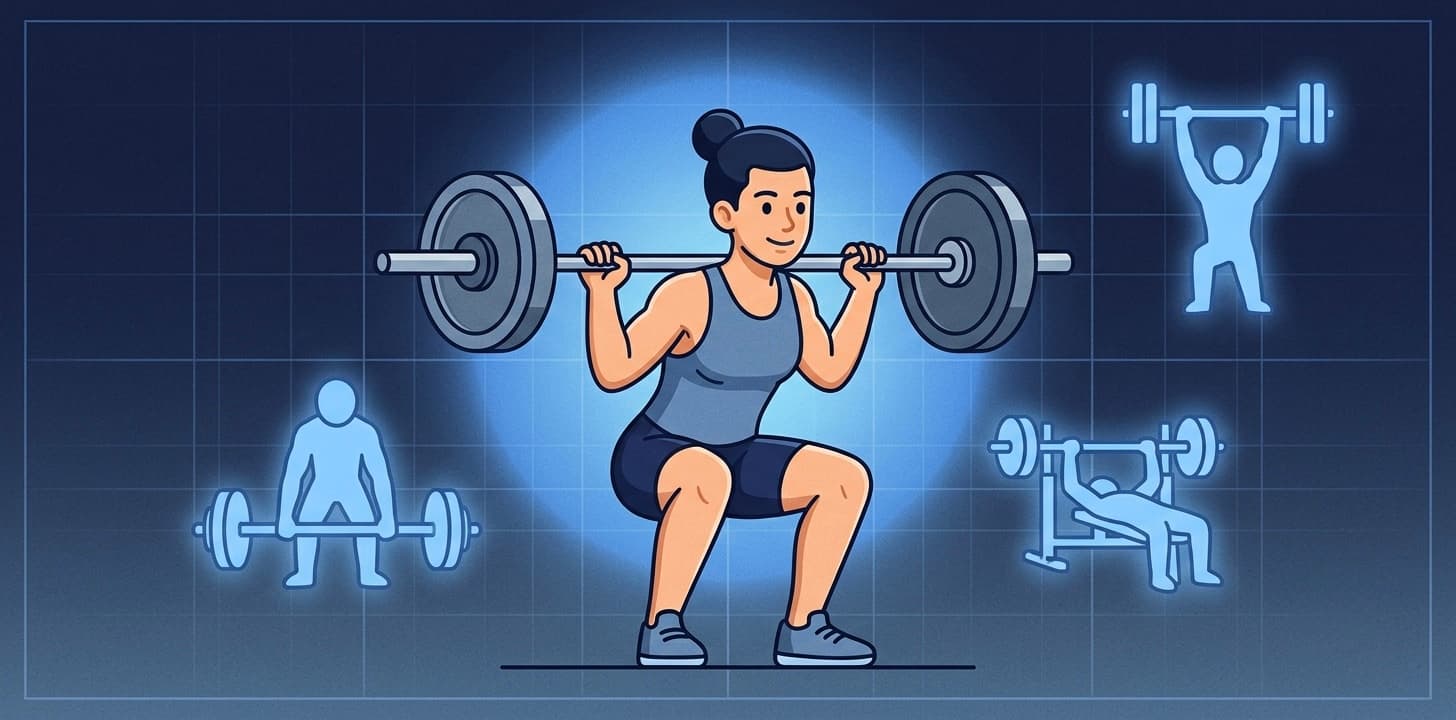
Training experience of 6+ months. You should already be comfortable with the foundational compound lifts: bench press, overhead press, barbell row, deadlift, and squat. If you are still learning form on these movements, a full-body or upper/lower split three to four days per week is a better starting point.
-
Schedule allows 5-6 gym sessions per week. PPL's main advantage is frequency: each muscle group gets trained twice every seven days. If you can only train three or four days per week, the split loses its edge over simpler alternatives.
The frequency argument is backed by a solid body of research. A 2016 meta-analysis by Schoenfeld et al. found that training a muscle group twice per week produced significantly greater hypertrophy than once per week, even when total weekly volume was equated. PPL naturally delivers that twice-per-week frequency without requiring you to cram too many movements into a single session.
Volume Recommendations
Volume, measured in hard sets per muscle group per week, is the primary driver of hypertrophy once intensity and effort are adequate. Here are evidence-based ranges for intermediate lifters:
| Muscle Group | Minimum Effective Volume | Maximum Recoverable Volume |
|---|---|---|
| Chest | 10 sets/week | 20 sets/week |
| Back | 10 sets/week | 20 sets/week |
| Shoulders (side/rear) | 8 sets/week | 16 sets/week |
| Quads | 8 sets/week | 18 sets/week |
| Hamstrings | 6 sets/week | 14 sets/week |
| Biceps | 6 sets/week | 14 sets/week |
| Triceps | 6 sets/week | 12 sets/week |
| Glutes | 6 sets/week | 16 sets/week |
Start at the lower end. Add one to two sets per muscle group every mesocycle (a training block of roughly four to six weeks) only if you are recovering well and progress has stalled. More is not always better. Exceeding your maximum recoverable volume (MRV) tanks performance and increases injury risk.
Structuring Each Day
Push Day
Every push session should start with a heavy compound press, move to a secondary press, then finish with isolation work for shoulders and triceps.
Push A (Strength Emphasis)
| # | Exercise | Sets x Reps | Intensity |
|---|---|---|---|
| 1 | Barbell bench press | 4 x 5 | RPE 8 |
| 2 | Seated dumbbell overhead press | 3 x 8 | RPE 7-8 |
| 3 | Incline dumbbell press | 3 x 10 | - |
| 4 | Lateral raises | 3 x 15 | - |
| 5 | Overhead tricep extension | 3 x 12 | - |
Push B (Hypertrophy Emphasis)
| # | Exercise | Sets x Reps | Intensity |
|---|---|---|---|
| 1 | Incline barbell press | 3 x 8 | RPE 7-8 |
| 2 | Machine chest press or dips | 3 x 10-12 | - |
| 3 | Cable flyes | 3 x 12-15 | - |
| 4 | Cable lateral raises | 4 x 15 | - |
| 5 | Tricep pushdowns | 3 x 12-15 | - |
| 6 | Overhead cable extension | 2 x 15 | - |
Notice the pattern: Push A leans heavier with lower reps on the primary compound, while Push B uses moderate loads and higher rep ranges. This combination covers the full strength-hypertrophy spectrum across the week.
Pull Day
Pull sessions follow the same structure: heavy compound pull first, secondary movement, then isolation.
Pull A (Strength Emphasis)
| # | Exercise | Sets x Reps | Intensity |
|---|---|---|---|
| 1 | Barbell row | 4 x 5 | RPE 8 |
| 2 | Weighted pull-ups | 3 x 6-8 | - |
| 3 | Cable row | 3 x 10 | - |
| 4 | Face pulls | 3 x 15 | - |
| 5 | Barbell curls | 3 x 10 | - |
Pull B (Hypertrophy Emphasis)
| # | Exercise | Sets x Reps | Intensity |
|---|---|---|---|
| 1 | Pull-ups or lat pulldowns | 3 x 8-10 | - |
| 2 | Chest-supported dumbbell row | 3 x 10-12 | - |
| 3 | Single-arm cable row | 3 x 12 | - |
| 4 | Reverse cable flyes | 3 x 15 | - |
| 5 | Incline dumbbell curls | 3 x 12 | - |
| 6 | Hammer curls | 2 x 15 | - |
One common question: where does the deadlift go? You have two good options. Place conventional deadlifts on Pull A as your first movement (replacing the barbell row), or place Romanian deadlifts on Leg Day as a hamstring-dominant hinge. Avoid doing both heavy conventional deadlifts and heavy squats on consecutive days. The systemic fatigue is significant.
Leg Day
Legs sessions should prioritize a squat or hinge pattern first, followed by unilateral work and isolation.
Legs A (Quad Emphasis)
| # | Exercise | Sets x Reps | Intensity |
|---|---|---|---|
| 1 | Barbell back squat | 4 x 5 | RPE 8 |
| 2 | Romanian deadlift | 3 x 8 | - |
| 3 | Bulgarian split squats | 3 x 10 each leg | - |
| 4 | Leg curl | 3 x 12 | - |
| 5 | Calf raises | 4 x 12 | - |
Legs B (Posterior Chain Emphasis)
| # | Exercise | Sets x Reps | Intensity |
|---|---|---|---|
| 1 | Conventional or sumo deadlift | 3 x 5 | RPE 8 |
| 2 | Front squat or leg press | 3 x 8-10 | - |
| 3 | Walking lunges | 3 x 12 each leg | - |
| 4 | Leg extension | 3 x 12-15 | - |
| 5 | Glute bridge or hip thrust | 3 x 10 | - |
| 6 | Seated calf raises | 4 x 15 | - |
Progressive Overload Within PPL
A program without a progression scheme is just a collection of exercises. You need a plan for adding load or volume over time. The simplest approach that works for intermediates is double progression:
- Pick a rep range for each exercise (e.g., 3 x 8-12).
- Use the same weight until you hit the top of the range on all sets.
- Increase the load by 2.5-5 lb (upper body) or 5-10 lb (lower body).
- Repeat.
For the heavy compounds on your A days, you can also use a linear periodization model: start a mesocycle at RPE 7 and add 2-5 lb per week until you hit RPE 9, then deload and reset. For a deeper dive into these strategies, read our progressive overload guide.
Rest Days and Recovery
One rest day per week is the standard for a 6-day PPL rotation. Place it wherever fits your schedule. Sunday is traditional, but Wednesday works well too if you prefer a mid-week break (you would run Push-Pull-Rest-Legs-Push-Pull-Legs).
A few recovery essentials:
- Sleep: Aim for 7-9 hours. Growth hormone release peaks during deep sleep, and a single night of poor sleep can reduce next-day strength output by 5-10%.
- Nutrition: Consume at least 0.7 g of protein per pound of body weight daily. For muscle gain targets, push that to 1.0 g/lb. If you are unsure how to set your daily calorie target, our TDEE calculator guide walks through the math.
- Deloads: Every 4-6 weeks, reduce volume by 40-50% and intensity by 10-15% for one full week. This is not laziness. It is strategic recovery that allows connective tissue and the central nervous system to catch up.
Common PPL Mistakes
Neglecting rear delts and upper back. Pressing twice per week without matching pull volume creates shoulder imbalances. Make sure your weekly pulling sets at least equal your pushing sets.
Skipping the B-day variation. If both push sessions are identical, you lose the benefits of exercise variety and rep range diversity. Use the A/B structure to cover different movement angles and intensities.
Too much arm isolation. Biceps and triceps already get significant work from your compound pulls and presses. Two to three direct sets per arm muscle per session is usually sufficient. Do not turn pull day into an arm day.
Ignoring fatigue management. If your performance drops consistently across the week, you may be exceeding your recovery capacity. Cut one to two sets per muscle group and reassess after two weeks.
When to Move On From PPL
PPL is not a short-term program. Many lifters run it for years. However, you might consider switching if:
- You can no longer recover from six sessions per week (in which case, drop to an upper/lower split at four days).
- You want to specialize for a specific goal like powerlifting peaking or sport-specific training.
- You are a true beginner. Start with full-body three days per week and graduate to PPL once your technique and work capacity are established.
Quick-Reference PPL Template
| Day | Compounds | Accessories | Total Sets |
|---|---|---|---|
| Push A | Bench 4x5, OHP 3x8 | Incline DB 3x10, Lat raise 3x15, Tricep ext 3x12 | 16 |
| Pull A | Row 4x5, Pull-ups 3x6-8 | Cable row 3x10, Face pull 3x15, Curls 3x10 | 16 |
| Legs A | Squat 4x5, RDL 3x8 | BSS 3x10, Leg curl 3x12, Calf raise 4x12 | 17 |
| Push B | Incline bench 3x8, Machine press 3x10-12 | Flyes 3x12-15, Lat raise 4x15, Pushdowns 3x12-15, OH ext 2x15 | 18 |
| Pull B | Pulldowns 3x8-10, Chest-sup row 3x10-12 | Cable row 3x12, Rev flyes 3x15, Inc curls 3x12, Hammer curls 2x15 | 17 |
| Legs B | Deadlift 3x5, Leg press 3x8-10 | Lunges 3x12, Leg ext 3x12-15, Hip thrust 3x10, Seated calf 4x15 | 19 |
Total weekly volume lands around 103 hard sets: a moderate-to-high volume approach that most intermediates can recover from. Adjust up or down based on your individual recovery and the principles outlined in our best compound exercises guide.