Full Body Training: Why Beginners Should Start Here
8 min read · April 2025 · by Manikanta Sirumalla
Full Body Training: Why Beginners Should Start Here
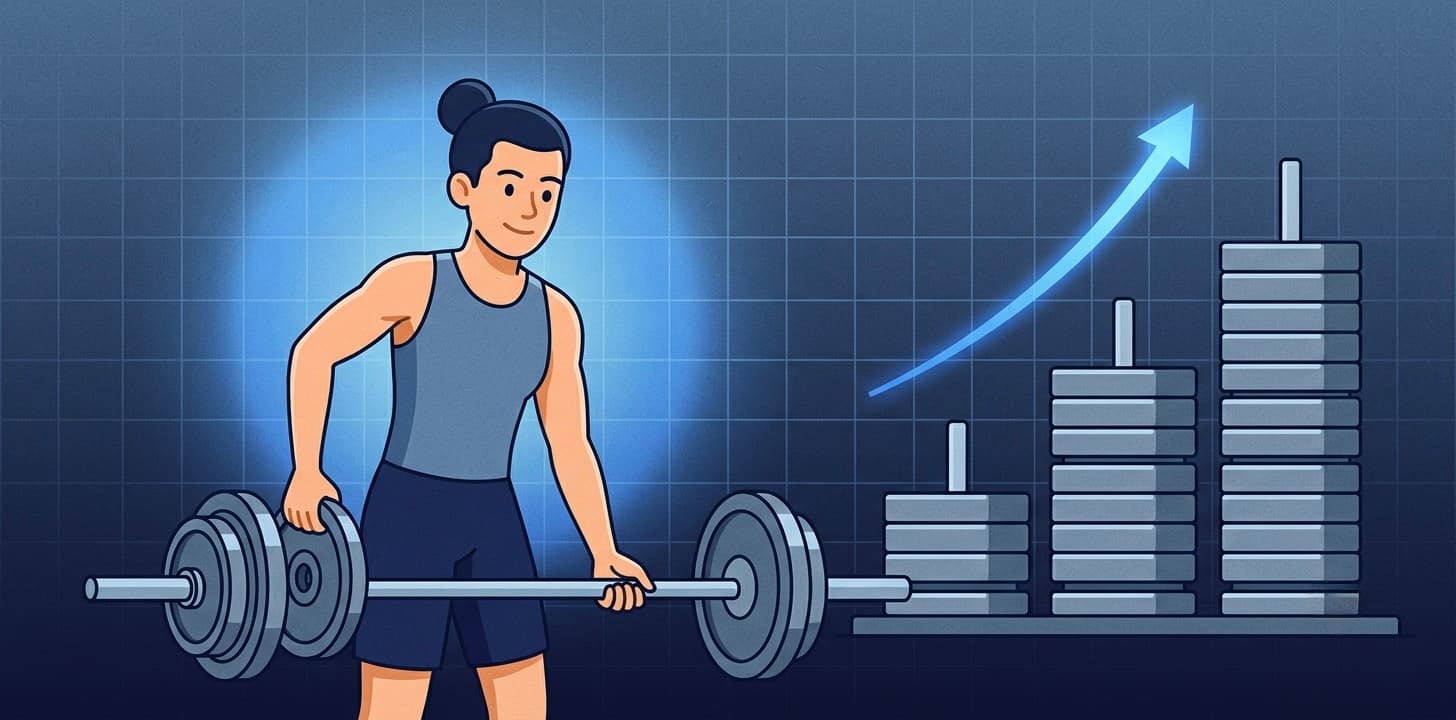
A novice lifter can add 5 lbs to their squat every single session for the first three to six months of training. That rate of progress (roughly 60-120 lbs in half a year) is the fastest they will ever experience. The only way to capture it is with a program that trains each movement pattern frequently enough to take advantage of rapid neural adaptation. That program is full body training, three days per week.
Why Frequency Beats Volume for Beginners
The case for full body training rests on one physiological fact: beginners recover from and adapt to training stimulus much faster than intermediate or advanced lifters. A 2019 study by Ralston et al. found that untrained individuals show elevated muscle protein synthesis for 24-48 hours after a resistance training session, compared to 12-24 hours in trained individuals. This means a beginner's muscles are ready to be stimulated again within two days, and leaving them unstimulated for a full week (as body-part splits do) wastes potential growth.
Training a movement three times per week also accelerates skill acquisition. The squat, bench press, and deadlift are motor skills. Like any skill, they improve with practice frequency. A beginner who squats three times per week accumulates 156 squat sessions in a year. A beginner on a body-part split who squats once per week gets 52 sessions. The difference in technique development is enormous.
This is why every credible novice program (Starting Strength, StrongLifts 5x5, GZCLP) uses a full body approach. The specifics vary, but the principle is universal: high frequency, moderate volume per session, and aggressive linear progression.
The Big 5: Your Foundation
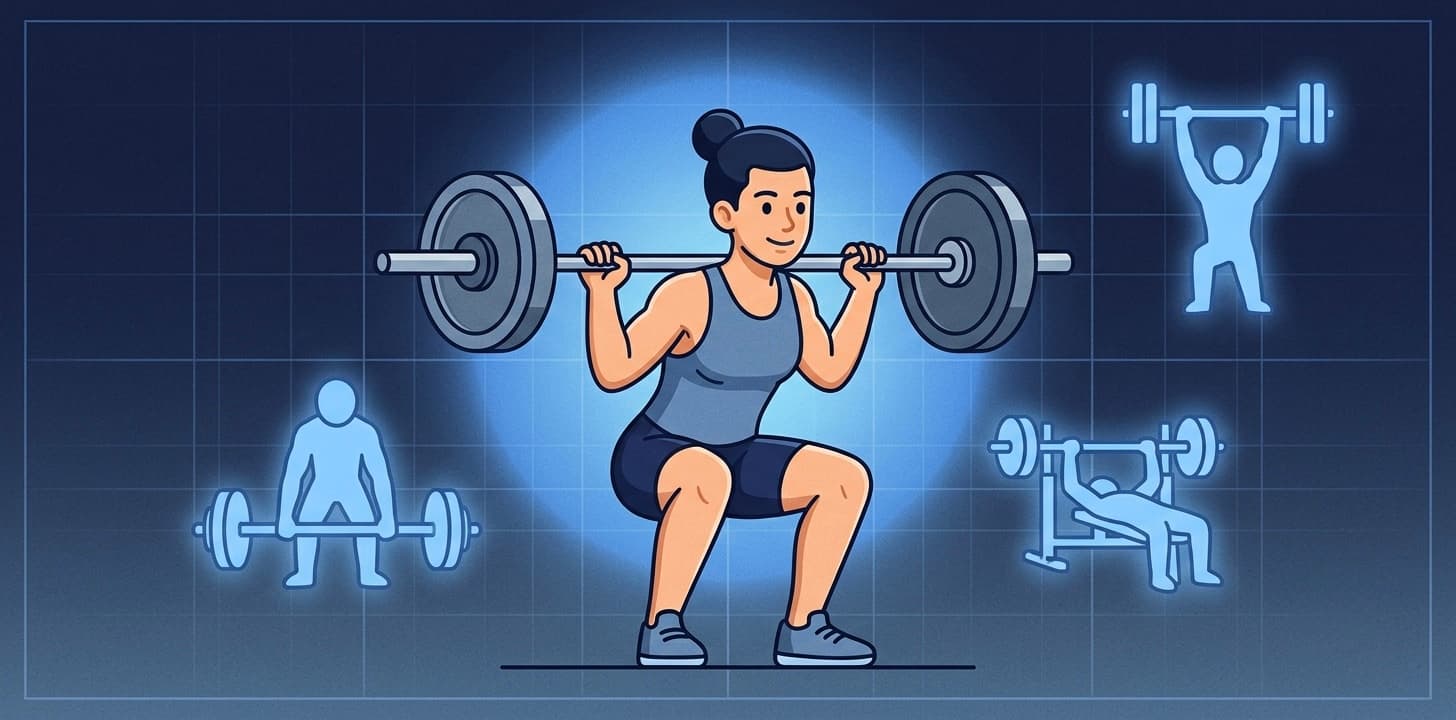
A full body program is built around five compound movement patterns. These are not just exercises: they are categories of movement that, together, train every major muscle group in the body. The specific exercises you choose within each pattern can vary, but the patterns themselves are non-negotiable.
1. Squat pattern: barbell back squat or goblet squat. Trains quads, glutes, and core stability. The back squat is the gold standard, but goblet squats are an excellent starting point for lifters who need to develop hip mobility and core bracing before loading a barbell.
2. Hinge pattern: conventional deadlift or Romanian deadlift. Trains the entire posterior chain: hamstrings, glutes, spinal erectors, and grip. The deadlift is the heaviest movement most people will ever perform, and it builds functional strength that transfers to everything from sports to carrying groceries.
3. Horizontal press: barbell bench press or dumbbell bench press. Trains the chest, anterior deltoids, and triceps. Start with whatever variation lets you use full range of motion with controlled form.
4. Vertical press: standing barbell overhead press or seated dumbbell press. Trains the shoulders, upper chest, and triceps while demanding core stabilization. The standing barbell press is harder than it looks: expect your numbers to be roughly 60-65% of your bench press.
5. Pull: barbell row or dumbbell row. Trains the upper back, lats, rear deltoids, and biceps. Pulling volume should match pressing volume to keep the shoulder joint healthy from day one.
For a deeper look at why these movements deserve the center of your program, read our guide to the best compound exercises.
The Program: A/B Alternation, 3 Days Per Week
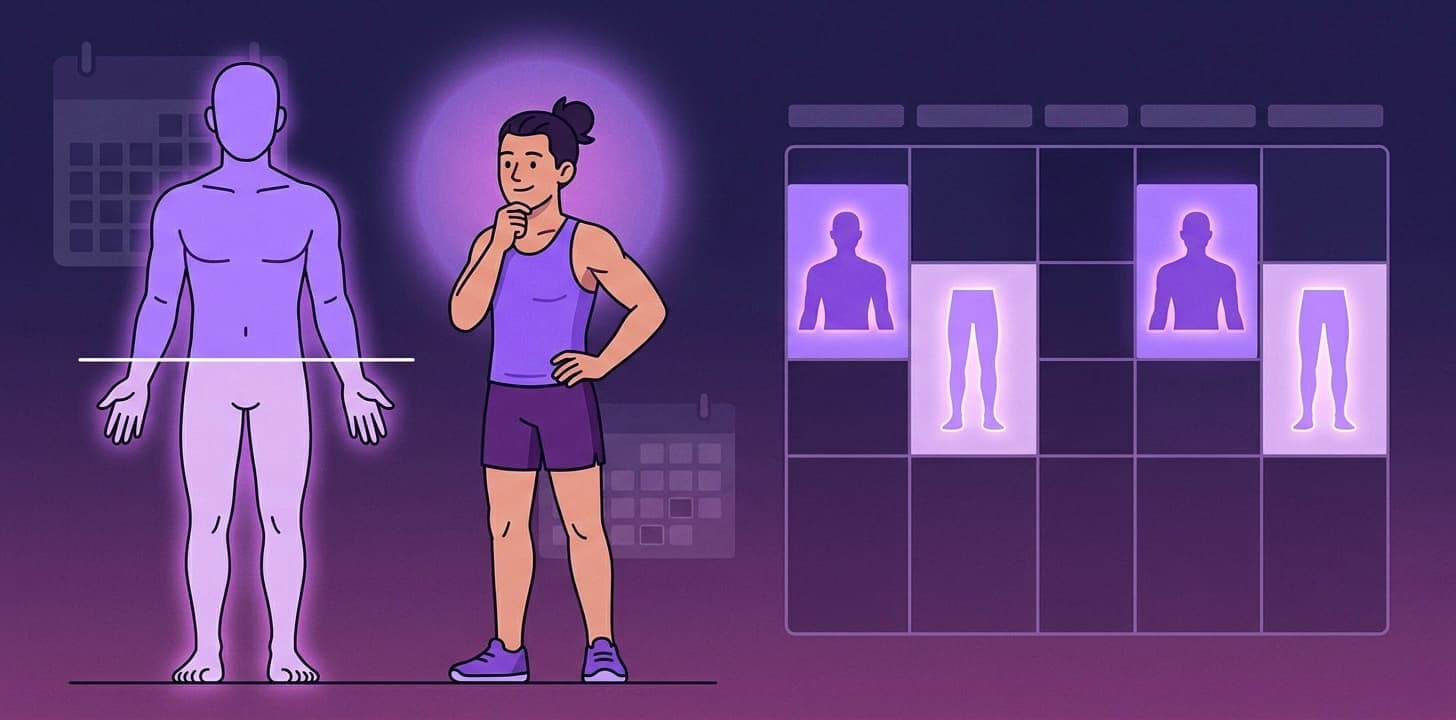
The simplest and most effective beginner structure alternates between two workouts across three training days. A typical week looks like this:
Week 1:
| Day | Workout |
|---|---|
| Monday | Workout A |
| Wednesday | Workout B |
| Friday | Workout A |
Week 2:
| Day | Workout |
|---|---|
| Monday | Workout B |
| Wednesday | Workout A |
| Friday | Workout B |
The pattern continues, alternating which workout you perform. This means each workout runs roughly 3 times every two weeks: enough frequency to drive adaptation without overloading recovery.
Workout A
| Order | Exercise | Sets x Reps |
|---|---|---|
| 1 | Barbell back squat | 3 x 8 |
| 2 | Barbell bench press | 3 x 8 |
| 3 | Barbell row | 3 x 8 |
| 4 | Dumbbell lateral raises | 2 x 15 |
| 5 | Plank | 2 x 30-45 seconds |
Workout B
| Order | Exercise | Sets x Reps |
|---|---|---|
| 1 | Barbell back squat | 3 x 8 |
| 2 | Overhead press | 3 x 8 |
| 3 | Conventional deadlift | 3 x 5 |
| 4 | Dumbbell curls | 2 x 12 |
| 5 | Face pulls | 2 x 15 |
A few notes on this structure:
Squats appear in both workouts. This is intentional. The squat is the most important lower body movement, and training it three times per week maximizes the beginner's rate of adaptation. Deadlifts are limited to Workout B because they create significantly more systemic fatigue. Three days of heavy deadlifts per week is too much for most novices.
Deadlifts are programmed at 3x5, not 3x8. The deadlift is uniquely taxing on the central nervous system. Lower reps per set allow better form maintenance and reduce fatigue accumulation. You will still progress the weight aggressively.
Accessories are minimal. Two sets of lateral raises, curls, face pulls, and core work are all you need at this stage. The compound lifts are doing the heavy lifting, literally. Adding four sets of bicep curls will not make your arms grow faster when barbell rows are already training them three times per week.
Total session time: 40-50 minutes. That includes warm-up sets. Full body sessions are efficient by design: you are in and out of the gym quickly, which matters for adherence.
Sets, Reps, and Progressive Overload
The rep scheme is simple: 3 sets of 8 reps for most exercises, 3 sets of 5 for deadlifts. Here is how progressive overload works within this framework:
Each session, attempt to add weight:
- Upper body lifts (bench, OHP, row): add 2.5 lbs per session
- Lower body lifts (squat, deadlift): add 5 lbs per session
That is it. No percentage calculations, no RPE charts, no periodization. Beginners do not need complexity: they need consistency and a clear progression target.
At this rate, here is what 12 weeks of progress looks like for a male beginner starting from an empty barbell (45 lbs):
| Lift | Starting Weight | Week 12 Weight | Total Gain |
|---|---|---|---|
| Squat | 45 lbs | 135 lbs (3x/week progression) | +90 lbs |
| Bench press | 45 lbs | 90 lbs (1.5x/week progression) | +45 lbs |
| Deadlift | 95 lbs | 185 lbs (1.5x/week progression) | +90 lbs |
| OHP | 45 lbs | 75 lbs (1.5x/week progression) | +30 lbs |
| Row | 65 lbs | 110 lbs (1.5x/week progression) | +45 lbs |
These numbers are realistic, not aspirational. Female beginners can expect similar percentage gains at different absolute weights. The key is that linear progression works, reliably, for months.
What to do when you stall: If you fail to complete 3x8 at a given weight for two consecutive sessions, reduce the weight by 10% and work back up. This is called a reset, and most beginners will need 1-2 resets per lift over a 6-month period. Resets are not failures: they are part of the process.
Recovery: The 48-Hour Rule
Full body training works because of the rest between sessions. Monday-Wednesday-Friday spacing gives you approximately 48 hours between each workout: enough time for muscle protein synthesis to peak and return to baseline before the next stimulus.
This means rest days are not optional. Training Monday-Tuesday-Wednesday defeats the entire purpose. Your muscles grow between sessions, not during them.
Recovery priorities for beginners:
Sleep: 7-9 hours per night. A 2011 study by Dattilo et al. found that sleep restriction reduced muscle protein synthesis by approximately 18%: nearly one-fifth of your potential gains, gone because of poor sleep. For a beginner riding the wave of rapid adaptation, this is an enormous missed opportunity.
Protein: 0.7-1.0 g per pound of body weight daily. A 170 lb beginner should aim for 120-170 g of protein per day, spread across 3-4 meals. This provides the raw material for muscle repair and growth. Timing matters less than total daily intake, but having 20-40 g of protein within two hours of training is a reasonable practice.
Hydration and nutrition basics. Eat enough to support training. Beginners who try to simultaneously lose fat and build muscle often end up doing neither well. If you are within a healthy body fat range (under 25% for men, under 35% for women), eat at maintenance or a slight surplus for your first 6 months to maximize strength gains.
When to Graduate to a Split
Full body training is not a permanent prescription. It is the optimal beginner phase, but it has a natural expiration. Here are the signs you have outgrown it:
Sessions are taking 75+ minutes. As you get stronger, warm-up sets take longer, rest periods between heavy sets increase, and you may need more total volume to keep progressing. When a full body session consistently exceeds 75 minutes, it is time to spread the volume across more training days.
Linear progression has stalled on multiple lifts despite 2-3 resets. If you have reset your squat three times and still cannot push past a given weight, weekly linear progression has run its course. You need a program with slower progression and more volume, which means a split.
You have been training consistently for 6-12 months. This is the typical timeline. Some lifters exhaust linear progression in 4-5 months; others stretch it to 12. Both are normal.
The natural next step is an Upper/Lower split at four days per week. This maintains twice-per-week frequency for each muscle group while allowing more exercises and sets per session. From there, lifters who want to train 5-6 days eventually move to Push Pull Legs.
The Compound Effect of Consistency
Here is what most beginners underestimate: showing up three times per week for six months is 78 training sessions. Each one takes under an hour. That is 78 hours of total gym time (roughly the length of a single long road trip) and in that time, a disciplined beginner can double or triple their strength on every major lift.
No program, supplement, or training hack produces results that even come close to what simple consistency delivers. The full body split is not glamorous. It does not have a clever name or a complex spreadsheet. It works because it removes every excuse not to train, gives your body exactly what it needs to grow, and builds the discipline that separates people who work out from people who train.